
Dietary Supplements
The dietary supplement industry is an ever-evolving, ever-growing industry. Roughly half of Americans report taking some form of vitamin or mineral supplement. But with the abundance of dietary and herbal supplements available, have you ever wondered if they actually contain what’s on the label? Or worse, that they may contain a harmful ingredient that’s not listed on the label?
What is a Supplement?
Like the name suggests, supplements are designed to “supplement” one’s diet with vitamins, minerals or nutrients you may not get from food. They’re not meant to replace our diet or become the primary source of nutrients.
Supplements come in many forms, but if a product is officially considered a supplement, it will have a Supplement Facts panel (see below) on the container label. However, there are exceptions to this rule. Certain products like energy drinks, nutrition bars and protein powder may have a Nutrition Facts panel because it may be considered a food by the FDA.
Loosely Regulated Industry
The dietary supplement industry is very loosely regulated and by being so, supplement makers don’t have to scientifically prove the products they’re marketing are safe before consumption. Furthermore, and even more concerning, is they don’t have to prove their products contain what is on the label. Because of the weak regulations and a lack of policy, supplements are at risk to becoming contaminated or adulterated with harmful ingredients.
This poses a great risk for consumers and especially for collegiate, professional and Olympic athletes who are randomly tested for prohibited substances. If they test positive for a banned substance, an athlete can lose eligibility, receive hefty fines and suspension, or receive a lifetime ban from their respective sport depending on the number of times they test positive.
It’s estimated that up to 25% of dietary supplements on the market could contain banned substances or other illegal drugs.
What to Look For On a Supplement Label
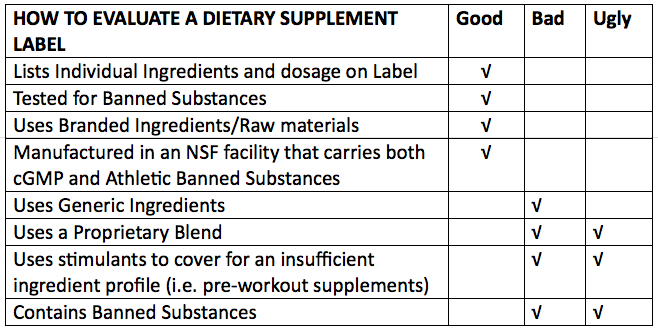
Evaluating a dietary supplement label for many consumers can be as challenging as trying to solve a 5000 piece puzzle as there is an abundance of information needed to determine the quality of the product you are purchasing. Furthermore, it’s extremely important to know if the product you consume is safe and does not contain a banned or potentially harmful ingredient. Below is a table you can use to help you understand how to evaluate a dietary supplement label.
Tested for Banned Substances
The most important characteristic of your dietary supplement is that it is clean and free of any potentially harmful substances – especially substances that have been banned for competition. Whether you participate in athletics or not, it’s important to make sure the product you’re taking is safe. NSF International created the Certified for Sport® program, which certifies that what’s on the label is actually in the bottle and that the product does not contain unsafe levels of contaminants, prohibited substances or masking agents.
Supplement Contains Banned Substances
Banned substances in dietary supplements are more abundant than ever and it’s not uncommon for collegiate, professional and Olympic athletes to test positive for a banned substance found in a dietary supplement. Some supplement companies are deliberately using banned substances in their supplements because their market is not the high performance athlete. Some companies focus on the general consumer. Not all substances banned for sport are illegal (i.e. Synephrine, aka Bitter Orange or Citrus Aurantium). At the same time, there are substances that have been banned by the Food and Drug Administration (FDA) that are still circulating in supplements (i.e. DMMA, Ephedra, SARMs).
If you choose to take dietary supplements
It’s important that you take a proactive approach and become fully informed, educated and aware of the marketplace.
• Recognize that no one person or organization will be able to provide all of the answers.
• Learn how, where and why risks exist in the supplement marketplace.
• Identify the tools and resources that can help minimize risk of consumption.
• Make no assumptions on the safety and effectiveness of a product.
• Consider that your best option may be to not take dietary supplements at all.
• Consult with your physician before taking any dietary supplements.